Exploring the cognitive features in children with autism spectrum disorder, their co‐twins, and typically developing children within a population‐based sample
Abstract
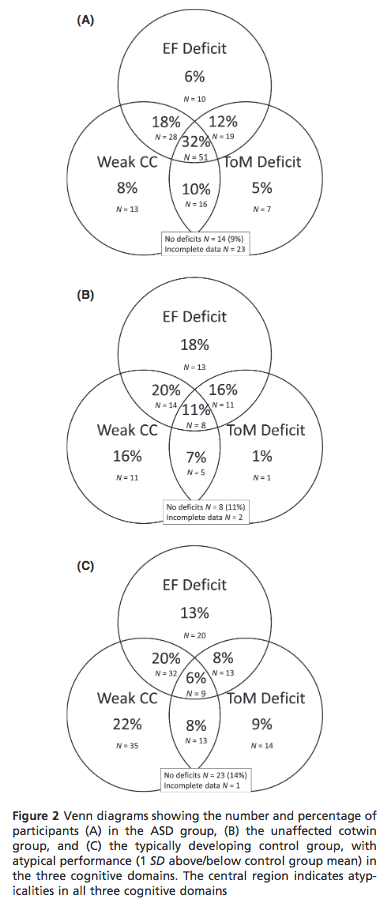
The behavioural symptoms of autism spectrum disorder (ASD) are thought to reflect underlying cognitive deficits/differences. The findings in the literature are somewhat mixed regarding the cognitive features of ASD. This study attempted to address this issue by investigating a range of cognitive deficits and the prevalence of multiple cognitive atypicalities in a large population‐based sample comprising children with ASD, their unaffected co‐twins, and typically developing comparison children. Participants included families from the Twins Early Development Study (TEDS) where one or both children met diagnostic criteria for ASD. Overall, 181 adolescents with a diagnosis of ASD and 73 unaffected co‐twins were included, plus an additional 160 comparison control participants. An extensive cognitive battery was administered to measure IQ, central coherence, executive function, and theory of mind ability. Differences between groups (ASD, co‐twin, control) are reported on tasks assessing theory of mind, executive function, and central coherence. The ASD group performed atypically in significantly more cognitive tasks than the unaffected co‐twin and control groups. Nearly a third of the ASD group presented with multiple cognitive atypicalities. Multiple cognitive atypicalities appear to be a characteristic, but not universal feature, of ASD. Further work is needed to investigate whether specific cognitive atypicalities, either alone or together, are related to specific behaviours characteristic of ASD.

Victoria E. A. Brunsdon
Postdoctoral Research Associate
My research interests include lifespan cognitive development, particularly social cognition and executive functions.